
Fractional CMO vs Full-Time CMO: Which Delivers More Value for Growing SMEs?

Updated: Nov 3, 2025

For small and mid-sized businesses, marketing leadership can be the difference between steady growth and stalled performance. But when budgets tighten and expectations rise, the question inevitably appears on the board agenda:
Should we hire a full-time Chief Marketing Officer (CMO) or engage a Fractional CMO?
Both roles carry strategic weight. Both promise accountability and commercial clarity. The difference lies in how they deliver — and what level of commitment, cost, and agility your business truly needs.
1. The Changing Role of Marketing Leadership
In the past, a full-time CMO was a given for any growth-focused business. They owned the marketing plan, managed agencies, and reported to the CEO.
But digital transformation changed everything. Today’s CMO must combine brand strategy, analytics, technology, data integration, and commercial accountability. It’s a demanding, expensive mix — one that’s often over-engineered for companies still scaling.
That’s where the Fractional CMO model emerged: senior-level marketing leadership delivered part-time, focused on measurable outcomes rather than headcount.
2. What Is a Fractional CMO?
A Fractional CMO is a senior marketing leader engaged on a part-time or contract basis — typically 1–2 days per week. They bring C-suite expertise without the full-time cost, focusing on:
Strategy and 90-day marketing plans
KPI frameworks and dashboards
Team and vendor alignment
Board-ready ROI reporting
Rather than managing every operational detail, a Fractional CMO builds the structure that enables teams and agencies to perform efficiently.
They act as both strategist and coach — embedded enough to influence daily priorities, yet independent enough to challenge assumptions and cut waste.
3. What Does a Full-Time CMO Do?
A Full-Time CMO is a permanent executive role responsible for all marketing strategy and execution. Typical responsibilities include:
Managing in-house marketing teams
Overseeing all brand, digital, and campaign activity
Aligning with the sales and product teams
Owning customer experience and retention strategy
Reporting marketing performance to the CEO and board
It’s an essential role for enterprise-level organisations where marketing drives millions in pipeline and requires daily executive focus.
However, the commitment — both financial and operational — is significant.
4. Cost Comparison: Fractional CMO vs Full-Time CMO
Role | Typical Cost | Commitment | Flexibility | Common in |
Fractional CMO | £3,000–£6,000 / month (1–2 days per week) | Part-time | High | SMEs & Scale-Ups |
Full-Time CMO | £120,000–£180,000 / year + benefits | Permanent | Low | Enterprises |
The cost gap alone can represent 60–70 % in savings. But the real value difference lies in focus.
A Fractional CMO spends their time on outcomes — measurement, clarity, ROI — while a full-time CMO is often pulled into management overhead, team issues, and internal politics.
5. When a Fractional CMO Delivers More Value
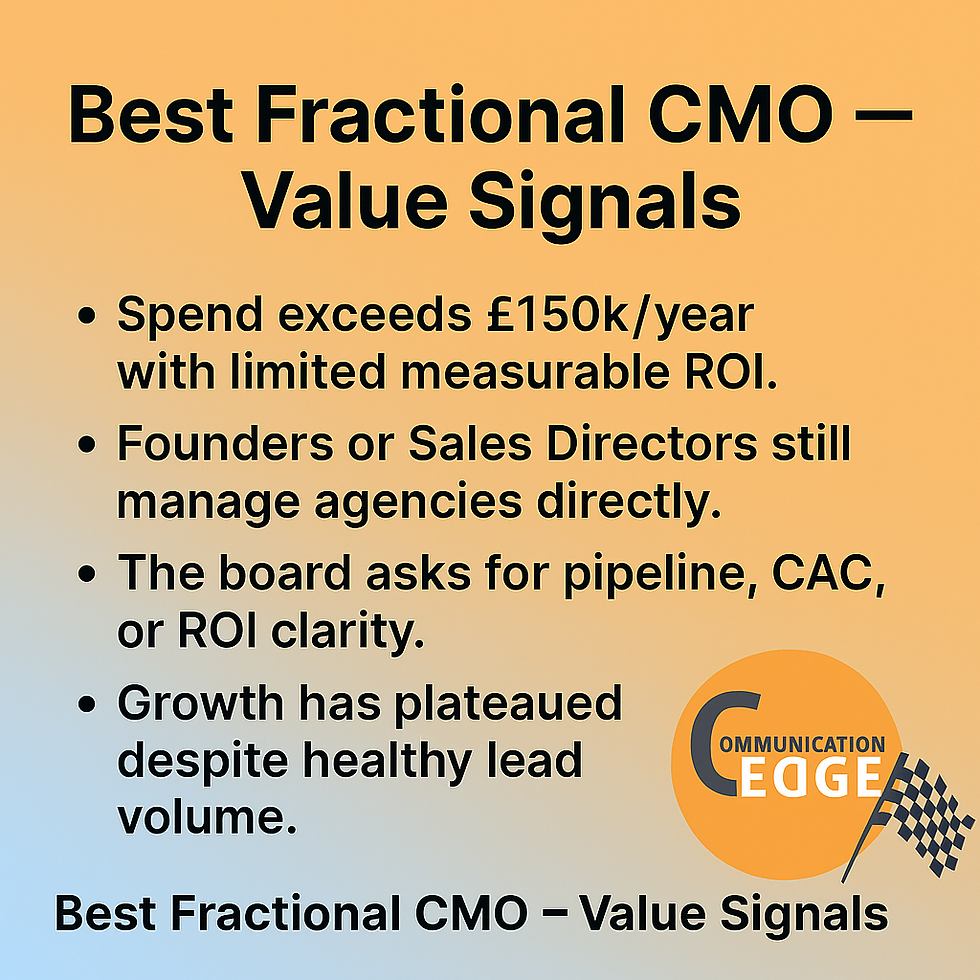
For growing SMEs, the value curve of a Fractional CMO is steep. Typical triggers include:
Marketing spend exceeds £150 k / year without measurable ROI.
Founders or sales leaders still manage agencies directly.
The board asks for CAC, LTV, or pipeline clarity.
Growth has plateaued despite healthy lead volume.
In these cases, the missing piece isn’t effort — it’s strategic oversight.A Fractional CMO builds that oversight into dashboards, KPIs, and financial reporting — connecting spend to outcomes in ways agencies rarely can.
6. When a Full-Time CMO Makes Sense
A permanent CMO becomes the better fit once the business reaches enterprise scale or marketing complexity demands constant executive presence.
Typical indicators include:
£1 m+ annual marketing budget
Multiple in-house teams (brand, product, performance, CRM)
Global or multi-region operations
Heavy reliance on long-term brand campaigns
Marketing directly influencing investor valuations
At this stage, daily strategic alignment across departments justifies the full-time hire.
7. Performance and ROI Benchmarks
Metric | Before (Agency-Led) | After 6–12 Months Fractional CMO | Typical Full-Time CMO |
Marketing ROI Tracking | Vanity metrics | Full ROI dashboard linked to pipeline | Board reporting team handles |
Lead-to-Sale Conversion | 2–4 % | 6–10 % | 6–10 % |
Cost Per Lead (CPL) | £250–£400 | £100–£200 | £150–£300 |
CAC Payback Period | 10–12 months | 4–6 months | 6–9 months |
Board Reporting | Manual spreadsheets | Automated dashboards | Dedicated BI team |
Fractional CMOs often deliver comparable — even superior — metrics in the first year, because they focus relentlessly on measurable performance rather than day-to-day admin.
8. Strategic Depth vs Execution Bandwidth

One of the misconceptions about Fractional CMOs is that “part-time” means “less strategic”.
In reality, it means sharper focus.
They typically dedicate:
20 % of their time on audit and measurement
40 % on strategy and planning
30 % on team enablement
10 % on reporting and iteration
This creates a cycle of accountability — every hour focused on what drives ROI, not maintenance tasks.
A full-time CMO, by contrast, spends much of their week managing meetings, budgets, and HR processes, often at the expense of innovation or analysis.
9. Cultural and Operational Fit
Consideration | Fractional CMO | Full-Time CMO |
Speed to Impact | Weeks | Months |
Cultural Integration | High (advisory and embedded) | Very High (full staff member) |
Independence | Objective outsider perspective | Subject to internal politics |
Scalability | Easily scaled up or down | Fixed structure |
Accountability | KPI-driven and commercial | Broader strategic mandate |
For growing companies, the blend of independence and accountability offered by a Fractional CMO often creates faster course-correction and less bias.
10. Building the Case for ROI
Boards and investors increasingly demand proof that marketing spend drives growth. A
Fractional CMO builds that proof through:
Integrated dashboards (spend → pipeline → revenue)
Unified attribution models
Automated reporting cadence
KPI reviews aligned with finance
The result: marketing becomes quantifiable. Instead of debating metrics, leadership debates strategy.
11. Long-Term Compounding Value
The real power of a Fractional CMO is cumulative. Each quarter builds on the last:
Quarter | Focus Area | Outcome |
Q1 | Audit & KPI Framework | Foundation for measurement |
Q2 | Strategy Execution & Enablement | Team and vendor alignment |
Q3 | ROI Optimisation & Dashboarding | Real-time accountability |
Q4 | Growth Planning & Board Narrative | Evidence-based scaling |
By year-end, the marketing engine is self-sustaining — equipped with data, leadership, and repeatable playbooks that outlast any single engagement.
12. Avoiding Common Misconceptions
“A Fractional CMO is just a consultant.”
False — consultants give advice; Fractional CMOs own delivery and reporting.
“Part-time means limited impact.
”Not when KPIs are defined. Impact is measured by outcomes, not hours.
“We’ll lose continuity.”
With structured dashboards and clear cadence, continuity increases — because dependency on individuals decreases.
13. When to Transition to Full-Time Leadership
Eventually, most fast-growth firms outgrow the Fractional model.The transition typically happens when:
Annual revenue passes £25–30 m.
Marketing becomes cross-departmental (brand, product, customer success).
The company operates across multiple countries or divisions.
At that point, a full-time CMO builds on the infrastructure the Fractional CMO has already created.
14. The Decision Framework
Question | If “Yes” → Fractional CMO | If “No” → Full-Time CMO |
Do you need board-level strategy now but not daily oversight? | ✅ | |
Is your team small (<10 people)? | ✅ | |
Is marketing spend < £1 m / year? | ✅ | |
Do you operate in a single region? | ✅ | |
Do you need constant cross-functional alignment? | ✅ | |
Are you planning a global brand expansion? | ✅ |
15. Key Takeaway
The choice between a Fractional CMO and a Full-Time CMO isn’t about scale — it’s about readiness.
If your business needs measurable growth, structure, and clarity more than day-to-day management, a Fractional CMO will deliver faster ROI and a lighter footprint.
When accountability matters more than headcount, part-time leadership becomes a full-time advantage.
FAQs — Fractional CMO vs Full-Time CMO
What’s the main difference between a Fractional CMO and a Full-Time CMO?
A Fractional CMO offers senior-level leadership part-time, focused on measurable outcomes and flexibility. A Full-Time CMO is a permanent executive overseeing all marketing operations.
How much does a Fractional CMO cost compared to a Full-Time CMO?
Fractional CMOs usually cost £3k–£6k per month (1–2 days/week). A full-time CMO costs £120k–£180k + benefits annually. Fractional models reduce cost by ~60 %.
Do Fractional CMOs work with existing agencies or teams?
Yes. They often coordinate multiple vendors and coach in-house staff, ensuring everyone aligns to one growth plan and shared KPIs.
Can a Fractional CMO deliver board-level reporting?
Absolutely. They build ROI dashboards linking spend, pipeline, and revenue — creating transparency and investor-ready confidence.
When should a company move from a Fractional to a Full-Time CMO?
Once marketing complexity demands daily executive oversight — typically beyond £1 m annual spend or multi-region scale — a permanent hire makes sense.
What results should SMEs expect?
Within 6–12 months, most see 30–40 % lower marketing costs, 2–3× pipeline growth, and data-driven clarity across all campaigns.
Is a Fractional CMO suitable for startups?
Yes, especially for Series A–B stage businesses needing strategic leadership without long-term salary commitment.
Does part-time leadership risk losing momentum?
No — because success is tied to structured plans, dashboards, and 90-day goals that keep teams accountable between sessions.
Can a Fractional CMO eventually transition to full-time?
Often yes. Many start Fractional, then become permanent once marketing scale and ROI justify it.
How do I choose the right Fractional CMO?
Look for experience across strategy, data, and execution — plus a proven record in measurable marketing transformation, not just agency management.


Comments