
When to Hire a fractional CMO?

Updated: Nov 5, 2025
Marketing can easily become busy — but not effective. Many SMEs and scale-ups pour hundreds of thousands into agencies, freelancers, and campaigns without ever connecting the dots between spend and growth. This article covers when to hire a fractional CMO and why.
Dashboards look healthy, yet pipeline stalls. The issue isn’t effort — it’s leadership.
That’s exactly where a Fractional CMO proves their value: bringing senior-level strategy, structure, and accountability — part-time, but with full-time impact.That's when you know you need to hire a fractional CMO.
The Value Comparison: Agency vs Fractional CMO
Below is a simple framework showing how leadership focus transforms marketing results.
Situation | Traditional Agency | Fractional CMO | Result |
Ad-hoc marketing with no clear ROI | Delivers outputs, not outcomes | Builds strategy and sets KPIs | Marketing aligned with revenue goals |
Multiple vendors, fragmented reporting | Provides channel reports | Unifies dashboards across spend + CRM | 360° view of performance |
Expanding team, no senior oversight | Outsources leadership | Provides embedded CMO 1–2 days / week | Faster decisions, lower risk |
Scaling or fundraising | Limited commercial insight | Delivers board-level narrative & metrics | Stronger investor confidence |
Each row represents a typical turning point in a company’s growth — when “more activity” stops producing results and leadership clarity becomes the multiplier.
From Ad-Hoc Marketing to Revenue-Aligned Growth

Most companies start marketing reactively — testing channels, outsourcing creative, and chasing leads. Over time, activity increases but alignment fades. Agencies report impressions, clicks, and followers, but leadership wants answers about pipeline and revenue contribution.
A Fractional CMO solves this gap by defining a measurable strategy before the next pound is spent. They:
Audit current spend vs outcomes.
Establish core KPIs (CPL, MQLs, CAC Payback, ROI).
Connect analytics, CRM, and finance data into one source of truth.
The result: every campaign is measured against commercial goals, not vanity metrics.
From Fragmented Reporting to 360° Performance Visibility
Agencies typically specialise in channels — PPC, SEO, or social. Each provides separate reports, but none show the whole funnel. Without unified data, leadership teams can’t tell whether growth is coming from content, paid media, or partnerships.
A Fractional CMO integrates all sources into unified dashboards across:
Spend vs pipeline (Google Ads + HubSpot / CRM).
Conversion rates across funnel stages.
Attribution of closed-won revenue.
Within weeks, the business gains a 360° view of marketing performance, highlighting what works, what doesn’t, and where to reallocate budget.
From Expanding Teams to Empowered Leadership
As marketing teams grow, coordination gets harder. Junior staff and agencies need direction, but full-time leadership costs £150k+. The absence of a senior figure leads to overlapping tools, inconsistent messaging, and slow decision-making.
A Fractional CMO fills that gap for 1–2 days per week, offering:
Board-level decision-making.
Mentorship for internal staff.
Agency oversight and budget control.
Because they’re embedded rather than external, they remove friction, streamline processes, and create accountability without adding headcount.
From Scaling to Investor-Ready Confidence

When growth accelerates or fundraising begins, investors expect more than marketing slides — they want commercial insight. A Fractional CMO reframes marketing in financial language:
Linking campaigns to CAC and LTV.
Demonstrating ROI trends over 6–12 months.
Showing payback periods and forecast accuracy.
This shifts marketing’s reputation from a cost centre to a measurable growth lever. The board narrative becomes data-driven, not anecdotal, building trust and investor confidence.
When to Hire a Fractional CMO: 4 Signs It’s Time for Strategic Leadership
If any of the following describe your business, you’re likely at the inflection point where a Fractional CMO delivers the highest return:
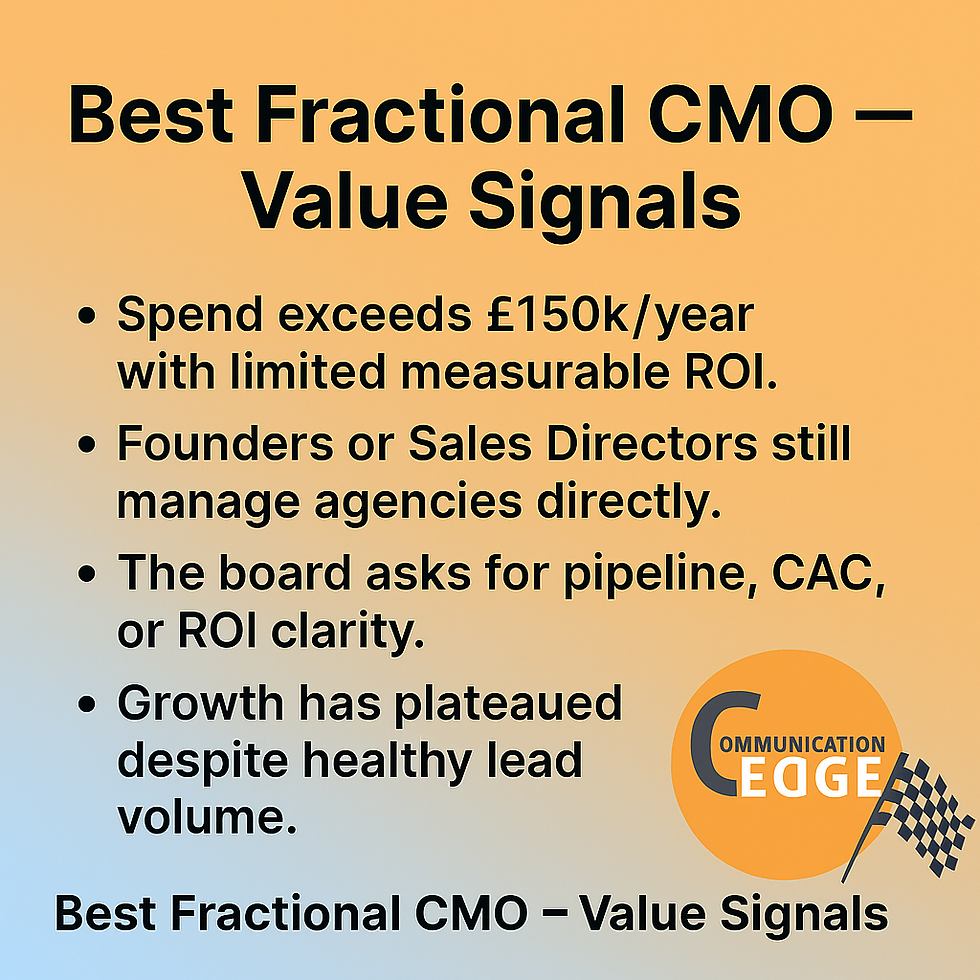
Marketing spend exceeds £150 k / year with limited measurable ROI.
Founders or Sales Directors still manage agencies directly.
The board asks for pipeline, CAC, or ROI clarity.
Growth has plateaued despite healthy lead volume.
In these cases, the issue isn’t effort — it’s missing strategic leadership and measurement architecture.That's when you hire a fractional CMO.
Quantifying the Return
A Fractional CMO’s value compounds over 6–12 months as reporting, strategy, and team maturity converge.
Metric | Before (Agency-Led) | After (6–12 Months Fractional CMO) |
Marketing ROI tracking | Vanity metrics only | Full ROI dashboard linked to pipeline |
Lead-to-Sale Conversion | 2–4 % | 6–10 % |
Cost Per Lead | £250–£400 | £100–£200 |
CAC Payback Period | 10–12 months | 4–6 months |
Board Reporting | Manual spreadsheets | Automated KPI dashboards |
These improvements translate to 30–40 % lower marketing costs, 2–3× pipeline uplift, and renewed executive confidence in marketing performance.
Why Value Grows Over Time
Unlike agencies focused on output, a Fractional CMO builds repeatable infrastructure — dashboards, frameworks, and playbooks — that scale with the business.Each quarter typically delivers measurable progression:
Quarter | Focus Area | Outcome |
Q1 | Audit & KPI Framework | Establish measurement foundation |
Q2 | Strategy Execution & Team Enablement | Align people and performance |
Q3 | ROI Optimisation & Dashboarding | Real-time accountability |
Q4 | Growth Planning & Board Narrative | Predictable, evidence-based scaling |
This compounding effect means every subsequent marketing pound works harder, supported by insight rather than intuition.
When Accountability Matters More Than Headcount

Hiring a full-time CMO makes sense once marketing reaches enterprise scale and requires daily executive oversight. But for most SMEs and growth-stage businesses, the priority isn’t a bigger team — it’s clarity, consistency, and control.
How to Hire a Fractional CMO?
Hiring a Fractional CMO is less about filling a vacancy — and more about proving marketing leadership ROI from day one.The right process ensures you bring in senior expertise that fits your goals, budget, and growth stage.
Step 1: Evaluate Whether You’re Ready
Before you hire a Fractional CMO, assess where your marketing stands today.You’re ready if three or more of the following are true:
Marketing spend exceeds £100k–£150k per year with unclear ROI.
Campaign activity has increased, but pipeline and revenue haven’t.
Multiple agencies or freelancers work in silos with no unified strategy.
You rely on founders or sales leaders to direct marketing.
You lack consistent reporting or visibility across CRM and spend.
If these resonate, you’re at the stage where strategic leadership — not more activity — drives the next phase of growth.
Step 2: Ask the Right Questions
The most successful engagements begin with clarity.Here are the key questions to ask before hiring:
What outcomes matter most? (ROI, CAC, lead quality, pipeline value)
What tools or systems must the CMO integrate with? (HubSpot, GA4, Looker Studio, etc.)
Do we need them to build internal capability or manage agencies?
What level of board interaction or reporting cadence is expected?
How will success be measured in 90, 180, and 365 days?
These questions filter out tactical marketers and help you identify strategic CMOs who can operate at board level — not just manage channels.
Step 3: Choose the Right Engagement Format
Fractional CMO models are flexible by design. Most UK SMEs choose one of three options:
Model | Structure | Typical Cost (UK) | Best For |
Retainer Model | 1–2 days per week | £3,000–£6,000/month | Ongoing strategic oversight |
Day-Rate Engagement | 1–2 days per month | £900–£1,200/day | Short-term or advisory projects |
Hybrid / Fractional Team | CMO + AI-enabled intern or marketing support | £4,000–£8,000/month | Full-funnel delivery with strategy + execution |
Tip: The best model depends on how embedded you want leadership to be.
If you need mentoring and measurable systems, go retainer or hybrid.
If you want quick audits or strategic input, day-rate fits better.
Step 4: Check Alignment and Fit
A Fractional CMO isn’t just another consultant — they’ll shape your culture, reporting, and marketing rhythm.Before signing, ensure:
Their experience matches your sector and growth stage.
They speak both marketing and finance — CAC, ROI, payback, LTV.
They can prove results with examples, dashboards, or playbooks.
Their communication style suits your leadership team.
Request a 30-minute audit or discovery call to test chemistry before you commit.
Step 5: Install, Measure, Optimise
Once hired, success comes from alignment — not speed.
Your onboarding roadmap should include:
Kick-off audit of marketing performance and spend.
KPI framework agreed with leadership.
90-day plan linking strategy, campaigns, and measurement.
Weekly dashboard reviews for visibility.
Quarterly board report proving ROI progression.
This structure turns your fractional engagement into a measurable growth engine — one where every campaign is tied to commercial outcomes.
Quick Visual Checklist: “Ready to Hire” in 5 Steps
Step | Focus | Outcome |
1 | Assess spend, data, and leadership gaps | Confirm readiness |
2 | Define success metrics | Clarity on ROI goals |
3 | Choose engagement model | Match format to budget |
4 | Verify fit and expertise | Cultural + strategic alignment |
5 | Set 90-day KPI plan | Measurable accountability |
In short:Hiring a Fractional CMO works best when you treat it like adding a senior business partner — not an external vendor.Define what success looks like, start lean, and scale once the ROI is proven.
Key Takeaway
Modern marketing success isn’t about doing more — it’s about knowing what works.The businesses that win are those that treat marketing as an investment, not an expense, and install leadership that can prove it.
A Fractional CMO bridges the gap between creative activity and commercial outcomes — ensuring that every campaign, every report, and every pound invested moves the business measurably forward.

FAQs — When a Fractional CMO Delivers the Best Value
What does a Fractional CMO actually deliver?
A Fractional CMO brings senior-level marketing strategy and leadership on a part-time basis — typically 1–2 days per week. They define measurable KPIs, align campaigns with revenue goals, and build the reporting structure that connects marketing spend to commercial results.
When does hiring a Fractional CMO make the most sense?
A Fractional CMO delivers the best value when marketing spend exceeds £150 k a year without clear ROI, when founders or sales leaders still manage agencies, or when boards are demanding better pipeline visibility and CAC clarity.
How does a Fractional CMO differ from a traditional agency?
Agencies focus on campaign execution and outputs. A Fractional CMO focuses on strategy, measurement, and leadership — unifying all activity across channels, agencies, and internal teams into one accountable growth framework.
What are the main benefits over a full-time CMO?
You get board-level marketing leadership without a £150 k+ salary. It’s ideal for SMEs that need strategic oversight but can’t justify full-time headcount. The result is 30–40 % lower costs with 2–3× pipeline uplift.
What measurable improvements should I expect?
Within 6–12 months, companies typically see:
ROI tracking via dashboards linked to pipeline
Lead-to-sale conversion rising from 2–4 % to 6–10 %
CPL falling from £250–£400 to £100–£200
CAC payback shrinking from 10–12 months to 4–6 months
How does a Fractional CMO create accountability?
They design a KPI framework, integrate CRM + analytics, and run structured board-ready reporting. This transparency replaces vanity metrics with commercial dashboards showing spend vs pipeline vs revenue.
Can a Fractional CMO work alongside existing agencies?
Yes — they often manage and align multiple vendors. The CMO sets priorities, benchmarks ROI, and ensures agencies contribute to a unified growth plan rather than isolated channel metrics.
How long before results are visible?
Early wins appear in 90 days as reporting clarity improves. The real ROI compounds over 6–12 months as measurement, strategy, and team capability mature.
What does the quarterly roadmap look like?
Quarter | Focus | Outcome
Q1 | Audit & KPI Framework | Measurement foundation
Q2 | Strategy Execution & Enablement | Aligned teams
Q3 | ROI Optimisation & Dashboarding | Real-time accountability
Q4 | Growth Planning & Board Narrative | Predictable scaling
What’s the long-term return on a Fractional CMO?
The compounding effect is lasting infrastructure — dashboards, playbooks, and leadership systems that keep working after engagement. Marketing evolves from ad-hoc spend to a measured growth engine.


Comments